¶ World Lore & History
¶ Lux Brumalis
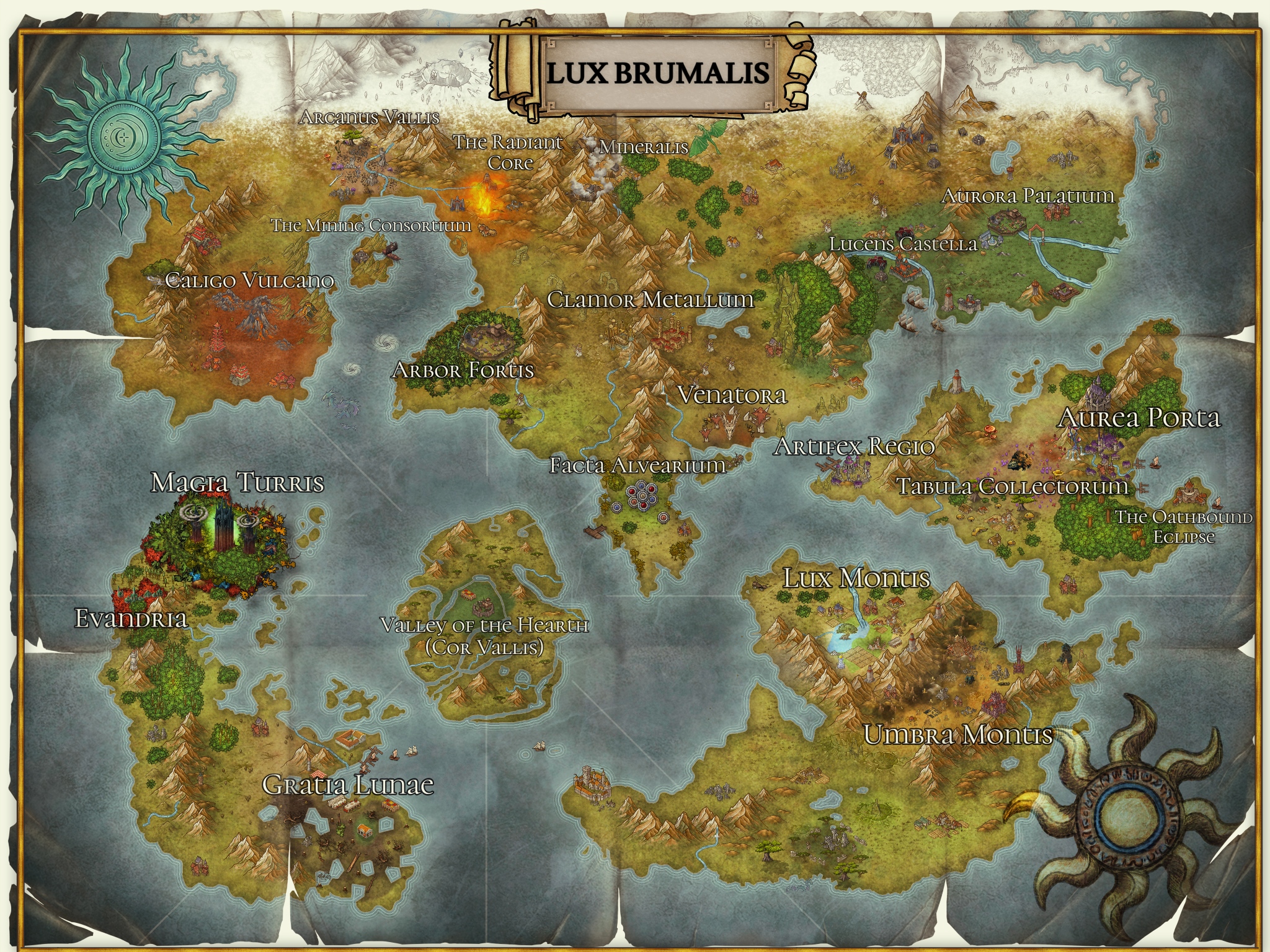
(See full-quality uncompressed image head to Discord)
¶ To submit a city-state and your own lore to this page, follow the instructions here
¶ Provinces
The world of of Lux Brumalis is split into nine major city states, each with their own unique people and stories, these are:
¶ Gratia Lunae (Moon's Grace)
The sound of gulls are never out of earshot when one walks down the famous boardwalks and through the busy harbours of Gratia Lunae, its people also darting as franticly as the birds, moving cargo and goods from warehouses to ships. It can be a shock for outsiders, particularly those of Solstice fervent areas to see devotion to the Goddess Nox in such open display, the people here are reliant on the tides she brings and so the Goddess of Death here is respected and her blessings are sought.
The district boasts many important and impressive structures, but none more grandiose then the Moon Pool, a gigantic hub of shipyards and drydocks that construct, repair and maintain the armada of ships needed to transport the various trade goods the world needs and many merchants will not deal with ships of lesser quality, built in lesser ports.
Behind the slick streets and endless warehouses lies the Bayou, these marshlands stretch for miles and are home to smaller communities that mostly keep to themselves, untrusting of the bustling city on their doorsteps that encroaches on their land bit by bit every day, and the people that damage their delicate home.
¶ Artifex Regio (Artists Region)
Artifex Regio is a city alive with sound, scent and movement. Where music drifts through every street and creativity is woven into daily life. The air carries the warmth of fresh bread and sweet pastries, mingling with the sharper notes of paint, oils and newly worked wood. Every corner feels intentional, filled with murals, sculptures and structures that reflect the individuality of those who create them.
By day, the influence of Solstice is unmistakable. Sunlight is captured and reflected through glass and pale stone. It bathes the city in warmth and colour, while open spaces invite performance, collaboration and shared expression. Life here feels forever renewing with growth and creativity encouraged at every turn.
As night falls, the city does not fade but transforms under the quiet reverence of Nox. Lanterns cast soft, shifting light across darker works of art and music becomes more intimate, measured and reflective. The night brings a different kind of expression, one that embraces stillness, shadow and depth without diminishing the vibrancy of the day.
Artifex Regio stands as a city of two halves that exist in complete harmony rather than opposition. Light and shadow, Solstice and Nox, they are seamlessly intertwined, creating a place where all forms of expression are welcomed and celebrated. A place where every individual is free to shape their own identity within its ever evolving tapestry.
¶ Lux Montis (Light of the Mountain)
Lux Montis stretches wide beneath an open sky. Where the mountain’s shadow never quite reaches. The first thing you notice is the light, constant, warm and unbroken, spilling across fields that seem to go on forever. You hear it in the rhythm of the place too: tools working soil, laughter carried on the breeze, the low hum of people who are busy but never rushed. It feels steady here, like everything moves with purpose but without strain.
The air is rich with life. Fresh earth, cut grain and the sweetness of ripening fruit linger as you pass between rows of crops and small clusters of homes. Meals are shared openly, often outdoors with long tables and easy conversation, as though abundance is something meant to be experienced together rather than kept. There’s a quiet pride in the work here, not boastful, just understood.
By day, the land almost glows. Sunlight settles into everything, be it the fields, the buildings or the people themselves,it gives the whole region a sense of ease and prosperity. It’s the kind of place where smiles come easily, where even hard work feels lighter under the warmth of it all and where the presence of Solstice is felt not through grand displays, but through simple constant growth.
And yet, just beyond the rise of the mountain, hidden by its vast shadow, lies a very different world. The contrast is hard to ignore once you’re aware of it. So much life and plenty exists here, while just out of sight others struggle without it. The distance between the two is small in measure, but vast in reality. Close enough to imagine reaching, yet far enough to remain untouched.
¶ Umbra Montis (Shadow of the Mountain)
Every thing in the sun casts a dark shadow, the same can be said of the great mountains that provide the world with its bountiful food, Umbra Montis is a forgotten place, hidden away in the darkness and left to fend for itself the people of this area are hardened like the ground they try to build their lives on, the lack of influence of either church is as obvious as it is needed, for no proselytizers would be welcomed even if they wanted.
Their once was signs of development but all were dashed as quickly as they came, but the little infrastructure they left has become the beating heart of the criminal empires that operate out of this dour, and sickly place, stone buildings last much longer then the rotten shacks the destitute can build and so these have been become safe havens of business best done in the shadows.
And if only the people of this easily forgotten patch of poverty had enough to deal with, whispers of the savages in the wastes moving closer, attacking those who dare venture out, and otherwise threatening what little hope there is, things are never looking bright deep within the Shadow of the Mountain.
¶ Magia Turris (The Magic Tower)
These dark woods hold many secrets and through the thickets and brambles it also hides many dangers, for those who would seek the knowledge of the academy of magics without its blessing find themselves on the wrong side of the warped woods, and gnarled thorns, although if one has the permission, or the fortitude, they will find themselves standing face to face with the great onyx black gates of the Magia Turris.
Part school, part laboratory, the great ashen tower holds all the arcane secrets of the world and spends its sleepless hours divining new ways to use the esoteric arts for those who wish its power, with enough housing around the tower to accommodate the many students and faculty, it has become an isolated, insular community, worried that those unworthy of passing the dark woods test might steal their work.
Although in recent years rumours of voices and campfires deep in the dark wood have been circling, whether these are lost students, opportunistic thieves, or an even more secretive communities that live in the darkest undergrowth, no one who learns the truth has survived to tell a soul.
¶ Clamor Metallum (Screaming Metal)
Sharp edges and sheer cliffs dot the impressive mountain range, often dubbed the "jewel box" of the world almost every ingot used by the craftsmen, and every gemstone by the artisans sees its first light in these mountains, its mineshafts and caverns run deep into the peaks into places Solstice's light would never reach, but faith in the Goddess is stronger here then even some temples, it seems the lack of her light in the depths makes those who delve appreciate her blessings when they can.
One of the church of Solstice's most impressive buildings, if not for its size but its location, is a small temple built on the peak of the tallest mountain in the range, its stained glass perfectly captures the sun throughout the entire day and built high up to stay bathed in her light as long as possible, the monks who live this high up are seen as some of the closest to Solstice's light, and many of the high priests start their journey here.
The mountains are not without their danger however, its name comes from the great howl that bellows through the peaks and passes like a scream of death, what makes this deafening noise worse is not knowing if it is simply the wind rushing through, or a great dragon roaring on the hunt, for the peaks are the favoured nesting grounds of the great lizards and many a life has been snatched in their talons.
¶ Aurea Porta (The Golden Gateway)
All the gold in the world is not enough to sate the greed of some, and the mints and treasuries of the Golden Gateway produce coins to keep the wheels of commerce turning and then some, feeding the pockets of the Nouveau riche and burgeoning middle class whose livelihoods can be summed up as a percent point on every transaction in the world; honesty has no place, and heart has no home here where finances and money move like arrows in a storm.
at the centre of the city lies the grand exchange, one of the newest jewels of the world, but don't let the glass and glamour of this enormous hall distract you or it will bewilder your senses and leave you without a single coin to your name, all in the game of finance. If however you look behind the sharks and bait you can watch investments and futures deciding the fates of lives they will never know.
Security is paramount in this financial powerhouse with mercenaries and solders in equal number all watching for any suspicious activity and protecting the investments of their employers, as such crime is almost non existent on these busy streets, at least not violent.
¶ Aurora Palatium (Dawn Palace)
Structure, order, and power, these three things are woven into the very streets of the Palace district, whether it be the rich smooth marble walls that clad the parlour houses and temples, the light touches of gold snaking like rivers through the walls and décor, to the lamps that flicker and shun the darkness even in the dead of night, you can feel the power that the church of Solstice wields here, a fitting home for the nobility, and the command structure of the Solsworn.
Away from the prying eyes and the delicate hands of the nobles you can find yourself in the heart of the Solstice war machine, great fortresses and military institutions that form the backbone of the armed forces and constabulary tasked with keeping order in this chaotic world, the Hearthstone Keep has survived countless battles against the untamed wilds and is a beacon of hope for any fervent to Solstice.
Of course there is a requirement of distraction from the affluent who call this city home, and the lavish nature parks, untouched by the advance in technology, to the mountains and tundra where the novel sport of skiing has taken root in the hearts of the young thrill seekers, Aurora Palatium's wealth and power can be felt in each corner like the warm rays of the light of Solstice.
¶ Caligo Vulcano (Mist Volcano)
It is a strange feeling to walk the soil of death herself, you feel her steely eyes watching you through the ash and mist of the great Volcano, waiting for its opportunity to strike, and it never has to wait long. Some have called the Mountain of fire the only light in Nox's eye, and the ever changing landscape would be hard enough to travel even if it was not also blanketed by the thick fog that smothers any life that dares to try,
The few souls that are daring or devoted enough to survive in this most hostile environment are certainly the closest in the eyes of the dark Goddess, each waiting for their chance to give their lives and souls to Nox, The stronghold of the Nocturn, the fallen souls of those who have given everything and more to Nox for all eternity.
An unknowable, hostile, and ever changing hellscape; where death is around every corner and its people welcome her.
¶ Minor Towns or City States
¶ The Radiant Core
Written by jceballos833
A people bound by the belief that all creatures begin their journey unrefined, and are forged through trial, discipline, and purpose.
We hold many guiding principles but one that stands the most “we are not born strong, we are forged.”
At the center of our city burns the eternal flame granted by Solstice, not as a deity we worship, but as a constant we understand. For it is through fire that all transformation is made possible.
The flame does not choose who you become, she reveals it.
Our society is ordered by stages of refinement as rank. All things begin with Stone and Tin, where we learn through endurance and imitation the ways of our people and those before them.
Progressing further leads us to Copper and Bronze, where responsibility and identity take form, this pushes us to choose our paths of Steel or Silver
The path of Iron and Steel embody strength, discipline, and action.
Whereas Gold and Silver take shape in diplomacy, clarity, and truth.
Above all stand the Great Flames, who lead through example and represent the unity of all aspects of refinement.
We do not pursue comfort, as it weakens resolve. Instead, we guarantee that what endures the flame is changed, and through that change, we are forged stronger
¶ Facta Alvearium
Written by profmachine
While Solstice and Nox rise and fall, the people toil. They sow and reap, make and break, build and destroy. Most people have little time to write down what is happening all around them, if they can write at all. Their deeds, big and small, have a home in Facta Alvearium.
The city is dedicated to the recording and sharing of all knowledge and populated by people who go forth, collect this knowledge, and then return to Facta Alvearium. Each person is a member of an Ordo, which they join for life. The city center is a large circular building, The Principalis, housing much of the world's general knowledge with other smaller circular buildings, The Alvearia, for the various Ordines to keep and protect their specific knowledge.
Upon joining an Ordo, people shed their former identity, giving up their surname, any titles and inheritance, and take on a new last name representative of their new and final passion. Their lifelong pursuit becomes the selfless dedication to the gathering and preservation of one particular type of knowledge in service of this world.
As Facta Alvearium is interested in the collection and sharing of all knowledge, some adherents to Solstice or Nox have, at times, looked disfavorably upon the good works of the People and Ordines of this great city.
¶ Arcanus Vallis
Written by roddock
Arcanus Vallis is a small, hidden town set in a quiet valley with a river running through it. It’s surrounded by steep hills, so most people in Lux Brumalis don’t really know it exists, or they think it’s just a story. The land there is really good for growing herbs, but not in a normal way. Plants grow faster, stronger, and sometimes in ways that don’t make sense, which is why the town became known for healing.
The town was led by women, and everything was built around shared knowledge and trust. The leader was Zelda Blackthorne, who wasn’t just a leader but also a warrior. She trained others in the town to fight so they could protect themselves if they ever needed to. Her husband, Caspian Blackthorne, led the medical and magical research. He focused on improving their healing methods and helped develop a lot of their more advanced remedies.
Arcanus Vallis became known, at least in stories, for having medicine that could do things no one else could. People said it could cure diseases, heal serious injuries, and even extend life. Most people didn’t believe it was real, but some did, and that’s what made it dangerous.
When the town was attacked, they didn’t go down without a fight. Zelda led the defense and the people of the valley fought back using both weapons and their knowledge of the land. Even with that, they were overwhelmed. The attack was strong, fast, and clearly planned. By the end of it, the town was destroyed. Zelda and Caspian both died during the battle, protecting their people and their work.
Now the valley is mostly ruins. Some buildings are still standing, but they’re overgrown and falling apart. The plants are still strange, and people say the area feels off, like something is still there. There are also rumors that not all of their knowledge was lost, but no one really knows what survived.
¶ Arbor Fortis
Written by Mr. Business
At the site of a long-forgotten battle, deep in the Viridis Milia forest east of the Clamor Parvus mountain range, lay Arbor Fortis, founded in the shadow of a crumbling fortress from a long-forgotten war. Only the trees remember the fortress’ true name now, but the quiet majesty of the ruins captured the imagination of Arbor Fortis’ first residents.
During its development, Arbor Fortis found itself in a notably unique position. To the East, artisans from Clamor Metallum were in need of more organic materials for some of their products. Despite the impressive amount of ore and jewels obtainable in the Screaming Mountains, the mountain range was mostly barren of trees and other flora. Tool handles, paper, rope, medicine and many other organic products were expensive commodities deep in the mountain range. Traders visiting the town were willing to pay high prices for their goods. As news spread, laborers and tradespeople from all over flocked to the forest and began the industrial practice the village is now famous for, logging.
To describe the growth of Arbor Fortis as explosive would be perhaps underselling it. At its peak, the village had roughly 1,000 inhabitants. Traders from Clamor Metallum were paying out the nose for lumber, and this made the most downtrodden and hard-working people flock to the forest to try and make their fortune. However no logging practice can be both sustainable and profitable for that many people, and the forest simply couldn’t support it any longer. Only 5 years after its founding, Arbor Fortis’ forest rangers put a ban on logging until the forest could grow back.
As the sounds of chopping and sawing ground to a halt, the natural sounds of the forest did not return, and silence dominated the now empty air. As the bandwagoners moved away, in search of new fortunes, only about 150 of the original villagers remained, determined to help the forest recover. Sadly, to recover from this kind of damage, it would take several lifetimes for Viridis Milia to regrow. Arbor Fortis nearly lost hope, but a new hope arrived, as a wandering student from Magia Turris came to their rescue. This student, by the name of Sylvia Cultor, arrived with the simple goal of developing a plant growth spell as her graduate project. She knew that such a spell would end hunger as they knew it all across the continent, and figured that the devastated Viridis Milia was an excellent place to test and develop it.
The villagers, overjoyed and relieved that the forest they called home had a chance to heal, welcomed her with open arms. They ushered her inside the walls of the crumbling fortress, and created a private workshop just for her use, offering the assistance of their most talented alchemists and herbalists. For magic initiates, the process of developing a spell from scratch is brutal trial and error. Even for a graduate student such as herself, Sylvia had much work ahead of her. While the town struggled to feed themselves, Sylvia was hard at work.
If you asked, most villagers could probably tell you about some of the more spectacular failures. Stories of creeping vines overtaking the town square, a wall of moss growing from the well, and arborial monsters crashing against the walls. Some members of the town guard are probably still removing splinters from that particular battle, but the village remained hopeful.
Finally, with the combined efforts of the town and one of Magia Turris’ finest, a regrowth spell was penned onto parchment only 18 months after starting. After teaching many of the basics of the spell to the town’s foresters, Sylvia was able to regrow much of the damaged forest in only months, not lifetimes.
In the following years after their recovery, Arbor Fortis has resumed their logging and forestry, but has put strict regulations on the practice. The village was able to reignite their trade with Clamor Metallum, and has become host to one of the schools of Magia Turris. The Cultor Ecological School was founded, and it was decided that classes would be held in the fortress that spawned the school’s first spell. After much rebuilding and refurbishment, the crumbling fortress walls had purpose once again. The townspeople still celebrate their magical savior with a festival, the Magia Silva, marking the day the growth spell was finished.
Before the shattering of Solstice’s crown, Arbor Fortis was on its way to becoming a powerful trading hub, specializing in lumber, medicine, and ecological research. While being a small village, their people were known for their hospitality and respect for privacy. Arbor Fortis also remains one of the more unique examples of a smaller village having an understanding of, and commonly practicing magic.
¶ Lucens Castella
Written by johnkoontz
Should one find themselves captivated by tales of ancient glory, they might wish to visit Lucens Castella. Its people cling to the old ways, rejecting many of the recent technological advancements. As such, the realm is ruled by feudalism. Despite its apparent unwillingness to accept change, the kingdom is burgeoning and prosperous, a result of the tenacity of those who call it home.
Honor, justice, chivalry, duty, and hard work are valued greatly in these lands, so there are scant few followers of Nox. Rather, the worship of Solstice has become highly established, with a small temple in every village. The kingdom's landscape is wild and verdant, owing to its lack of urbanization. Along the roads, commoners work at camps performing all manner of tasks and people of all social classes carouse at inns. The hamlets of the region always bustle with activity as folk diligently go about their days. The largest castle–and the largest town, which it overlooks–is called the Citadel, home to the royal family.
The castles that the region is most renowned for are garrisoned by large numbers of men-at-arms and knights in shining armor. Lucens Castella boasts one of the greatest militaries of any nation, with most men expected to serve in their lord's army for a time. There are many knightly chapterhouses scattered across the land, and it is the dream of many young men to perform a feat worthy of a place in one of their halls.
Of all the crafts, the arts of metallurgy are perhaps the most respected here. In order to support their martial culture, the land is filled with myriad forges where master smiths toil day after day to produce endless amounts of quality armor and weapons for highborn and lowborn warriors alike. Generally, the people take great pride in their work, whatever that may be, and strive to be the best they can at what they do. And when the day is done, the sound of merriment, laughter, and song can be heard throughout the kingdom.
Here, songs are sung and stories are told by all walks of life about the heroes and villains of yore and their deeds. The people aspire to honor tradition and their forebears. They offer hospitality to one another and even to outsiders, and if you conduct yourself with dignity, you will be most welcome among the rustic countryside and imposing keeps of the Kingdom of the Shining Castles.
¶ The Mining Consortium
Written by thealmightybacon
“He who strikes first, strikes hardest and hottest.”
The Mining Consortium is a privateering network of crew that form a resource driven nation northeast of the Caligo Vulcano. Bound not by crowns but by belief, reverent not to the sun but flames, ashes, metals and glimmering treasures. To them, simple truths as not found in the open world, but beneath it. They sail as far as necessary, often boarding ships to check its cargo for valuables. These miners believe that what is hidden under rock and soil must be claimed before any other hand can reach it. Outsiders are tolerated, even welcomed in passing, but are ultimately viewed like the surface itself something to be stripped away to reveal what lies beneath.
This Consortium is guided by figured head known as the Grand Sultan and supported by a council of Fleet Sultans bound by loyalty, coin, or quiet negotitions. A strict code of ownership and agreement keeps trade contracts as sacred. Each one sealed through ritual contracts signed in blood and heat binding both parties to their word on pain of death. they believe every living person hides there true self and value deep within just as every land conceals riches, and every secret uncovered must be hoarded until its worth peaks. The Caligo Volcano is seen as a living forge, heat and explosives are a tool for harvesting. Trees are only so many pounds of Coal to feed the Great Dragon, a large forge tucked deep withing a mining stronghold. Fables speak of great treasure vaults and archieves, though few live to tell there exact location. While they do not worship Nox outright they respect her domain for in death and ash the world gives up its most precious secrets.
Relationships
The Clamor Metallum is as called the Fuelvein as miner slang. Its vast forestsare viewed as seemingly never ended place to harvest lumber. Thus making the Clamor a lusted target for the Consortium. At times loose contracts have been negotiated, often declared period of times where mining and lumbering are halted. Rumors have spread that, contract exist directing Mining Crew to intentional target the Arbor Fortis's Forrestry.
The Radiant Core is viewed as competition in a similar way as teams in a game of sport. However, the Consortium leave little room to interpretation they play for blood. The Path, There Great Flame are viewed as over religious dribble distracting from a miners work. However even amongst this rivalry there is an acknowledgement of equals. Amongst all there neighbors The Radiant Core is seen as the most respectable. Custom even is to buy these "Metalkin" a drink when crossing paths at Taverns or Bars.
¶ The Oathbound Eclipse
Written by flormjon
The oathbound Eclipse is not a mercenary group but rather a contractual empire which has already been around for atleast a century. Passed from Grandfather, to father to son. They do not devote themselves to Solstice or Nox but rather are in between. The sun reveals and the moon conceils, both complete the truth.
Their main identity: Warcraft, Commerce and binding oaths. "To hire them is not to request an aid, it is to finalize an outcome.
Over this century they have created multi continent range of influence in Lux Brumalis. With their HQ located at the peninsula of the Aurea Porta, due to their business interests and their more lucrative contracts there they stood at the pinnacle of wealth.
The company deals in the following:
Solar aspect: Trade negotiations, military contracts, Diplomatic enforcements and visible honor and prestige.
Lunar aspect: Assasinations, intelligence networks, economic sabotage and silent enforcement of broken terms.
At the hearth of the Oathbound eclipse lies a massive ever growing record. Every contract ever accepted, every clause fulfilled or broken, every debt owed. The book is sacred to the company. Rumors would even say that entire kingdoms have fallen because of a single line within it.
They are as much traders and negotiators as warriors. They control trade routes, protection contracts for caravans and ships and strategic monopolies.
¶ Mineralis
Written by bun1927
When one thinks of The Glimmering City, they think of wealth, industry, innovation, but most of all, Solstones.
Carved into the hollowed base of The Howling Mountain, far north from Clamor Metallum, the city originally functioned as a forward outpost for the city.
They were sent to tame the mountains, one group focused on agriculture, the other on quelling the number of dragons in the region.
With exposure to the elements being a concern, the expedition was tasked with delving into the mountain to establish a proper base of operations.
It was through these initial efforts that the Solstones came to light.
These unique gemstones, first discovered at the heart of Ululatus Mons (The Howling Mountain), possess an unusual duality, absorbing light (or the lack thereof) from their surroundings. When first found it appeared as a black stone with patterns of the starry night sky, but when held in the sun’s light for a time, it shone brightly like the sun itself.
Believed to be a gift from Nox to Solstice, hidden away in darkness until the time was right, it quickly became an expensive, but highly sought after mineral for many of the faithful and noble among the people of Lux Brumalis.
This desire for this wonder from the goddesses, transformed the plan for the hunting outpost into a quarry.
Between the delving itself and the transportation of the mineral through the cold, monster-ridden mountains, it was a harsh and thankless existence.
Decades of poor work- and living conditions went by until a violent uprising of the miners and forced removal of Clamor Metallum’s leadership, allowed the quarry to break free from the yoke of their masters and proclaim themselves a sovereign city-state.
The families of those who initially led the rebellion now serve as its rulers, a council of barons, each holding sway over various sections of the city.
Over time, a rift began to form between the ideologies of the hunters-turned-miners and they split apart, the group focused on agriculture becoming The Radiant Core, and the latter remaining in the mountains.
Mineralis remains devoted to the goddesses, whilst the Core is focused more on the self.
This rift has led to friction between the two groups and skirmishes and small battles are quite common.
¶ Venatora
Written By psyborgsage
About 120 years ago, a tribe of expert hunters settled the land to the south east of Clamor Metallum and created a village known as Venatora. The areas around the "jewel box" of the world were frequently attacked by dragons. To the settlers, this provided an opportunity for both wealth and glory. Dragons are valuable prey, not only for the resources they provide and guard, but also because people are willing to pay a hefty sum for their destruction. The primary motivation, however, was the challenge of slaying the world's most dangerous beasts. To the Venatores Draconum, there was no greater glory than showing the world that they are more powerful than dragons.
Everyone in the village is in some way or another involved in the hunting of dragons. There were three main groups, each with their leaders: Venatores (hunters), Fabricae (craftsmen), and Custodes (trackers and scouts). The common culture of these three was built upon intense discipline and training. Intense mental and physical training through meditation and physical exercise was the norm. The Venatores specifically had additional tests and rituals that involved symbolically taking the strength of dragons. Reverence for Solstice or Nox was seen as a distraction from the great hunt. To other cultures, those of Venatora had a no-nonsense survivalism which could come off as rude, but the group also commanded great respect for their impressive feats.
The group was very efficient and resourceful, using every bit of the slayed dragons that they could. Dragon bones were frequently used to add structural stability to their buildings, which themselves often incorporated dragon hide and scales. Armor and clothing was specially made to be resistant to dragon breath and was exported out to other lands to sell. The tribe also exported alchemical and cooking ingredients: dragon meat, fire and frost glands, special mushrooms only found in their dens. All this money would feed back into providing resources to further strengthen the village.
The group took on many contracts, making them quite wealthy. The dragon population dwindled, including the most dangerous beasts of all, the black dragons. All was well until one day the largest dragon they had ever seen attacked Venatora to take revenge for his slain kin. The settlement was lit aflame by dragon fire and many were burnt alive. They managed to damage the dragon enough to convince him to retreat, but more than half of the population had been killed. The Venatores Dracorum named that day the Black Calamity and named the attacking monstrosity Tenebrax. The group recovered, albeit significantly weaker than before, and began taking contracts again. The most senior Venator, Halvek, became the de facto leader of the village. Several years later during a dragon slaying contract, the Venatorum killed a great black matriarch and all of her eggs. They learned too late that this was Tenebrax's mate. Halvek sacrificed himself to wound the beast, who then flew away to the south east.
Only a few from the party managed to survive the encounter, and made their way back home. Upon their approach they saw smoke coming from the location of Venatora. When they made it there they saw the village in ruins. Tenebrax apparently aimed to do to them what was done to him. He scorched the village to the ground killing all the men women and children in the process. The once bustling village was left a smoldering corpse of its former glory. A graveyard of bones, human and dragon.
Of the few who made it back, even fewer survived their injuries. Even now, the ground of their abandoned village still shows the effects of the dragon fire, nature only now starting to reclaim it. To others this affair has reinforced popular fear of dragons as well as the opinion that it is folly to try to exterminate their kind. It is unknown how many members now survive, but the number could be counted on one hand. Survivors commanded a premium in mercenary circles, especially for contracts involving the slaying of beasts.
¶ Other Stories & Info
¶ Culinarium Imperium (The Culinary Dominion)
Locations: Artifex Regio and Aurea Porta
Written by alec_blackwall
For over two hundred and fifty years, the Culinarium Imperium has stood as the highest authority in culinary training across Lux Brumalis. It is not a school for those who simply wish to cook. This academy is where Chefs are forged. Entry is limited to those who are sponsored, selected, or put forward by someone willing to stake their name and resources on the candidate. Students come from every city-state, usually carrying the expectations of whoever sent them. From the moment they arrive, they are held to a standard that does not bend.
The main academy operates out of Artifex Regio, where its kitchens are known across the world. The first eight years for a stundent is focused on control, repetition, and consistency. Students work the same techniques until precision becomes habit and mistakes become rare. Those who cannot keep pace simply stop progressing an over time, fewer remain.
As training continues, expectations shift. They are no longer evaluated only on execution, but on judgment. They’re expected to understand ingredients, timing, and presentation well enough that every decision has intent behind it, every dishes are assessed for more than quality. They must serve a purpose, whether that be clarity, restraint, or impact. By this point in their education, it becomes clear who can adapt on the fly and who relied too heavily on instruction.
Those who do not advance, they either remain in they city state of Artifex Regio, working in its kitchens, taverns, private houses, or leave entirely. The city states benefits from these formal students , but the distinction is understood. To have trained at the Imperium is respected, but to have graduated is a greater achievement.
In the final two years, the remaining students are sent to Aurea Porta. There the academy removes its structure and places them into environments governed by wealth and influence. Students take on contracts, fulfill private commissions, and work under constant scrutiny. Patrons observe closely. Some invest. Others test limits. A few look for ways to leverage what the students can provide. A meal in Aurea Porta is never just a meal. It can influence reputation, secure agreements, or close doors just as quickly.
Only a small percentage complete the full ten years. Those who do are recognized across all city-states as graduates of the Culinarium Imperium. Among them, and even rare few distinguish themselves above the rest and are granted the title Lord or Lady of the Golden Table, a mark of mastery recognized well beyond the academy itself.
The Imperium doesn’t claim to create talent. It finds it, tests it, and pushes it as far as it will go. What remains at the end is expected to stand on its own.
¶ The Abripio
Written by Arielle
Moonlight skims the sand, cold underfoot and smelling of whale oil and salt. The night sky shimmers overhead making the bar feel both close and unknowable. A low, persuasive hum rises from the water’s lip, soft as a lullaby but edged with something patient and hungry, tugging at a child’s curiosity toward the tide.
On the ragged edge where the sea and ice argue and the wind cartwheels along the shore, the people of the little settlement learned to listen. Not just to the shout of hunters or the creak of a sled, but to the small, worrying sounds that swallowed the space between the waves: the hus of gulls folding back over water, the hollow sigh of tide drawing teeth across pebble, and when the moonlight lay a cool knife on the bay the low, lulling hum that could move a child’s feet toward the wet. They called that sound sirenias in gossip and lullaby, and mothers clutch their amulets and parents gathered toddlers close when the hum came down out of the dark sea. The Abripio, the elders said, was not just a warning but a presence. It was part animal and part human myth, a thin seam where fear and care stitched together.
No adult has ever seen one, the tales are woven together from the memories of those few children who survived their encounter. Those who claim to have say they have fingers as long as driftwood and hair that lay like kelp over their shoulders. Its skin is a color like molding bread and its eyes the green of shallow water. It wore, some said, little more than a sarong and an amulet of its own. It has no face of its own but a moon-lit reflection of a familiar face shimmering in the pool.
It is a child that learns to converse with it, by telling it stories on the river banks, by teaching the names of rocks and eddies, by sharing with the child the songs of the river luring the child ever further toward the lapping waters in spite of the boundaries set by their parents of the shore and danger. Every few winters, some would vanish, and the hum would be blamed again.
¶ In Love and Death
Written by Arielle
The night of the elopement was supposed to be their beginning. Julien was not seen fit enough for his beloved Elara and his request for her hand in marriage had been denied by her father and mother both. Through secret messages on the rings of songbirds they had hatched a plot to meet by the old willow tree and escape together to a land far away.
The woods were not as empty as Julien had prayed. As he reached the ancient willow, a lantern in his hand a small, flickering hope, the shadows suddenly detached themselves from the trees around him.
It was not Elara who stepped into the light, but her three brothers. Their faces were grim masks of family pride, illuminated by the torches they suddenly sparked into light. Julian had no time to flee; they were upon him in an instant, a flurry of heavy boots and iron-hard grips.
“You thought to steal a daughter of our house?” the eldest growled, his voice thick with a cold righteous fury.
Julian fought, his boots sliding in the mud as he gasped for air, but he was one man against three. Blows came like hail in the storm of the brothers outrage. They dragged him toward the very tree where he had planned to start a new life. While two held him pinned against the rough bark, the third tossed a thick coarse rope over a sturdy low-hanging limb.
The bark of the willow groaned under the weight of the hemp, Julian’s pleas were cut short as the noose cinched tight, fibers biting into the skin. With a brutal, coordinated heave, they pulled.
Julian’s world narrowed and the last thing he saw before the darkness took him was the flicker of torches retreating through the trees like a sunset on his mortal life. In silence he swayed, the branch groaning overhead as the proud willow’s branches sagged as though in mourning for the unjust death amongst its limbs.
The rustle of the willow leaves sounded like weeping as Elara reached the clearing. There her brothers had not just stopped their flight, they had exacted a permanent price for his devotion.
Elara collapsed at the base of the ancient tree, her fingers clawing into the moss and dirt. She did not pray to the goddess of harvest or sun. Instead she pressed her forward to the cooling soil and screamed a plea into the dark, calling upon the Goddess Nox, the mistress of the quiet places and the final sleep.
The air grew impossibly still. A mist began to coil around the willow’s trunk, silver and heavy. Front the shadows, a figure emerged, tall and raped in robes the color of a starless sky. The Goddess did not come with a scythe, but with an ache of ancient empathy. She knelt and pulled Elara into an embrace that felt like the coming of winter: cold, yet strangely peaceful.
“You ask for a stitch in a shroud,” Nox whispered, her voice like the falling snow, “I can give him back his spark but the sun will no longer know him. He will be a creature of the borders, silent as the grave he nearly filled.”
“Let him be mine in the dark,” Elara sobbed, “that is enough.”
The Goddess reached up, her pale hand brushing Julien’s cold cheek. With a sharp snap the rope withered to ash and Julien fell, not as a corpse, but as a man gasping his first breath in a second, shadowed life.
He stood, his skin the color of dusky moonlight and his throat bore the dark permanent bruise of the noose. When he tried to speak the name of his beloved only a soft whistle, like the wind through the reeds, emerged. But when he reached for her his touch was steady and his eyes burned with recognizable devotion.
Julien took Elara’s hand, his grip firm and cool. They did not look back at the village or the families that had sought to break them. Instead they turned into the deep, untamed woods where the shadows lived. Together they would step into the silver light of the moon and disappear into a freedom that only the dead and truly daring can ever know.
¶ The Bloody Exchange
Written by Arielle
A secret and secluded room hidden inside the gilded exchange resides a special board room for the world’s richest and most influential people. While the average capitalist speculates on grain futures there are those who would rather fix results and agree about the most gruesome of fates. In times of war, even lives are decided by this rumored cabal.
One such time was during the world war hundreds of years ago when the province of Rubinus Stepis, located south of Umbra Montis, had its fate decided by the whims of the secret oligarchy.
The room was circular, lined with shelves of ledgers that held the debts of provinces. At the center sat the World-Table, a massive slab of obsidian etched with the silver inlaid borders of the known world. There were no chairs, only five velvet-lined pedestals for the men who viewed the globe as a ledger to be balanced.
The leader, a man whose family name had been scrubbed from public record for a century, tapped his long silver rod against the province of Rubinus Stepis.
“The grain speculation in the outer halls is a distraction,” he spoke to grab the attention of his fellows, “the real harvest is here. The fate of Rubinus Stepis is open for bidding. Do we let the war simmer or do we provide a definitive end?”
The ivory blocks representing the legions were moved with clinical precision. The men spoke in the shorthand of those who owned the steel, the coal, and the very bread the soldiers ate.
The man at the far end, his frame casting a bulbous shadow against the obsidian, slid a heavy wax-sealed bond toward the center.
“I find the current map too cluttered,” he wheezed, wiping spittle from his wrinkled face. “I have never seen a city state completely wiped off the map. Not occupied, not annexed.. Erased. Let it burn. I want to see a blank space where their history used to be. Leave no survivors to mourn the loss.”
The leader picked up the bond, inspected the seal and nodded. Money did not change hands power simply shifted its weight. He snapped his fingers and a page emerged from the velvet curtains.
“Inform the generals of Clamour Metallum and Umbra Montis to bypass the sieges. Take no prisoners. All that Rubnius Stepis has is now theirs for the taking. Total liquidation of the assets human or otherwise.”
The page vanished back into the shadows to carry out the sentence of death. Around the obsidian table, the men didn’t celebrate they simply adjusted their sleeves.
“A bold liquidation,” one remarked checking their gold pocket watch, “but efficiently handled.”
“Indeed,” another agreed, leaning his silver rod against the shelf of debts. “Now what is for lunch?”
¶ Trolls
written by dreamiblu
The trolls of the land have long been a nuisance to Lux Brumalis, with destructive tendencies and a natural instinct to squash out overabundances of life by harbingering chaos and death. Most of their crude offerings and prayers are made to Nox, revering the lady of evening for the safety she provides in shadow and honoring her place in the necessary cycle of life and death. Though not intelligent, they are formidable foes to most humans, living in small clans and hunting in the night. All humans know the best way to outwit a troll is to wait for dawn, for Solstice’s light turns them to stone; but with the sun blotted and the safety of city walls far away, they pose a much greater threat. Though formidable, it’s important to know what kind of troll you’re dealing with to best exploit their weaknesses.
There are seven known troll clans of varying rarities, usually decorated with tattoos proclaiming their homage:
The Flame Raiders are said to be descended from lava trolls, since gone extinct, though their legacy lives on in this incredibly hostile clan. They are arrogant and the least intelligent of all trolls, and will argue about anything, usually with their fists. The easiest way to insult a Flame Raider is to insinuate they’re not truly descended from lava trolls… though why anyone would provoke a troll intentionally is not for the wise to understand.
Golden Grove Defenders, or “Grovers,” are part of the largest troll clan in Lux Brumalis. Unlike other trolls they worship Solstice, bringing balance to the troll community by protecting and preserving nature. They are also fantastic cooks, and utilize rare spices and ingredients like frog’s bladder and rootmold to brew fresh meads and soups. Tasty!
A Livstroll is the rarest of them all, and seeing one in the flesh is considered a certain omen of death. Thankfully, they have not been seen in thousands of years—though many trollkona* stories tell of ancient and powerful Livstrolls, with sage healing magic so attuned with nature that they were able to merge their beings with the trees. Having a good connection with nature and speaking to trees for wisdom is a way to pay respect to or divine guidance from the ancient Livstroll spirits.
“Tree speak, if troll listen.” —Unknown
(trollkona* = young troll)
Crystal Clan trolls are especially adept in elemental magic, more so than other clans. Their ability to see into the future and decipher prophecies makes them clever and powerful beings, often following your trail long before you lay eyes on them. Crystal trolls are notoriously brutal, often predicting the moves of their enemies and using instinct to win territorial and physical disputes, though as a newer clan, their traditions and magic are seldom understood.
The Northern Raiders are sworn enemies of the Flame Raiders, born on the peaks of distant snowy mountains. They travel south in large hordes over the span of weeks, sometimes months, slowly ambling toward their enemies in the night and standing still in the day. They are able to withstand the sunlight better than most trolls, though they still turn to stone in the light and see much better in the dark. Despite being tough, they are easy to outrun, and will happily give up an impromptu hunt for easier prey.
The trolls of Clan Springwood are known for being incredibly mischievous and playful. They are quicker than most and love to tell riddles and play tricks. These nimble and quickwitted trolls started the tradition of sitting underneath bridges, waiting to eat unsuspecting passersby. They can also weave nature magic to grow specialized herbs and flowers, though only for those who can correctly answer their nearly impossible riddles.
“Human say, ‘Burn that bridge wen we gets to it.’ Troll say, ‘wait here for lunch!’” —Unknown
Finally, the Lyestroll clan, not to be confused with Livstrolls, are masters of balance and illusion. Legend claims they were the first trolls, born to balance out Solstice’s gift of life by bringing death, or to balance Nox’s harsh winters by nurturing the land till spring. Their most terrifying powers are illusion and duplicity—just when you think they’ve given up the fight, these trolls can produce a near-identical homunculus, continuing this process through combat until their energy is spent.
Most troll clans do not get along, and though there can be outliers, they become very territorial in matters of land and blood. Rival clans will attack each other on sight, and may even use magic to gain advantage over one another. Because of this, they are actually excellent shamen, and specialize in treating wounds with natural and magical means. They have many sacred yet primitive traditions as well, like bone readings and storytelling, and even strange superstitions, such as sharing a riddle with anyone they cross paths with for good luck. Their low intelligence and bloodlust has made them inept in speech, and their tools and clothes have always been primitive, if they have any at all. They do have excellent memories, and pass stories through generations through word of mouth and paintings along cavern walls, proving to Nox and the rest of the world that they were once here, and always have been.
The existence of trolls goes back as far as Solstice’s greenest forests and Nox’s darkest nights. According to the original stories of the Lyestrolls, the mightiest of them all was a hulking beast-king named Thorn, heralding from what is today known as Caligo Vulcano. The legends say he was responsible for divining the first prophecy, and assigning purpose to the once aimless creatures, for which his name is eternally echoed in legend:
“So com Nox an keep troll safe,
So com Sol an giv troll life.
We guard forest, hill an cave,
An bring deth, wild an rife.” —Thorn, Troll King
In order to achieve balance across as much land as possible, Thorn decided to split the trolls into mighty clans, inspiring them with competitive, chaotic spirit in Nox’s name. The lava trolls, who would eventually form the Flame Raiders, stayed behind in what would become Caligo Vulcano, while the frost trolls headed up north to the bitter cold mountains, where they would eventually form the Northern Raiders. The Livstrolls crossed the southern lands and seas to inhabit the dense forests around the modern day Magia Turris, and the Lyestrolls spread themselves throughout each region, providing guidance and wisdom to the new clans by sending their homunculi around the world to act as spirit guardians. Where life was created, they raided and pillaged, bringing death until the land found balance. When winter came, they shielded the forests from harm till the warm light of spring returned. All was well for hundreds of years, until the humans came, seeking land to settle, soil to cultivate, wood for their homes and safety for their young. At first, Thorn commanded the trolls to fight back, defending the land and its delicate balance from the new invaders, but one by one, their numbers were beginning to dwindle. The lava trolls were the first to falter, sending messengers north to beg the frost trolls for aid. When they refused, an inextinguishable rivalry was born of betrayal and guilt. Seeing the slaughter of young trollkona and destruction of the land, the Lyestrolls retreated from the clans, seeking safety in their illusion magic and staying far from conflict, and far from saving their kin.
The reign of Thorn ended a few years later when he joined the front lines of conflict, defending the dark magia forests alongside the last of the Livstrolls. As his kin fell around him, Thorn was struck down by a group of human soldiers, and his body burned on the bloody shores. Horrified, hopeless, and defeated, any remaining Livstrolls retreated forever, binding their souls to the trees, never to be seen again. With only three clans remaining and completely at war with one another, the alliances and purpose of the trolls was lost, and what remained of them splintered into smaller and smaller groups, eventually forming three additional, smaller clans: The Grovers, the Crystal Clan, and Clan Springwood. They spent hundreds more years terrorizing the humans of the far western shores and even other troll clans, but never dared to step foot within range of city walls to enact revenge for their fallen king…
Stories were passed down over generations of clans, bloodlines became mingled and muddled, and some even abandoned the original prophecy of balance altogether in favor of Nox, her protection from the sun, and her harsh winters which weakened the human enemies. The new belief was called “The 1-7 Rule,” which dictated that trolls are made only to serve Nox and cause destruction to all life, including enemy clans. It would become incredibly popular after the fall of Nox’s comet, lasting exactly 17 minutes, plunging the world into darkness. In those 17 minutes, the troll clans sprung to action: half of them pillaging the human towns, enacting centuries worth of long-deserved revenge, the other half fighting against them, desperately trying to preserve the balance of the original prophecy. When the darkness lifted and the damage was realized, the trolls leapt to action once more, half in search of Solstice’s crown to return balance to the forests, the other half right on their heels, ready to squash them out and corrupt the world forever.
¶ The Spirits
Written by AznPope
Origin of the Spirits
The Spirits believe that Solstice, creator of life, brought forth light into the world and manifested her will through the creation of The Great Tree. It is believed that at the dawn of time, every living thing existed in perfect harmony within the boughs of the Great Tree. Nurtured by Solstice herself, the Tree of life was the physical embodiment of the goddess’s power. It was the conduit from which she brought forth all life. To Nox the tree was the personification of everything she despised in her sister.
The Spirits also believe that all life sprang forth from the tree and as all manner of creatures who dwelled there multiplied in the abundance it offered, more space was needed. Solstice sacrificed parts of her creation, creating the Earth. Its trunk forming the ground, the branches grew into forests of abnormally large trees, and the sap pooled into vast bodies of water. Long before human cities clawed their way into the wilderness and stone replaced trees, there was a great forest, vast, breathing and eternal.
Nox countered her sister any way she could . Trees would not grow in her darkness. She created blight and vested some creatures with an insatiable hunger. She brought forth drought and pestilence to bring death to her sisters’ creations. The Spirits looked upon Nox with distain but understood that their duality brought balance. Until the eclipse.
The Spirits of the Forest believe that Solstice vested upon her ancient wilderness a living consciousness. The roots of the trees communicated through a mycelium network and a communal hivemind called The Great Spirit of the Forest. They believe that all humans and trees of the Forest are beings of comparable consciousness.
A such, the Spirits view tree chopping as murder. To them wood was as precious as gold and should be retrieved from creatures whose who had already returned to the great collective consciousness. Following the cataclysmic events which shattered balance the Spirits know that no life can be created within the darkness of Nox and so their stance on the felling of trees has become much more extreme.
Humankind also resided in the Tree of Life and its subsequent creations, the Earth. Within mankind Nox sensed weakness, that they could be used as a weapon against her sister. She vested within humans an insatiable hunger for excess. With the discovery of fire, mankind made many leaps in innovation at the expense of the other living beings of the great forest. It wasn't long before humans began logging the forests to build their homes, their towns and cities. At first, the Forest seemed like a passive entity, merely accepting of being chopped down for industry.
The Great Spirit of the Forest recruited an unlikely ally, Likeminded human beings. These humans could not be bent to the Spirit's will like the lesser beasts of the forest, but they could be influenced through other means. Persuasion, manipulation, deceit was attempted with some success. There was one type of persuasion that worked better than the others. The promise of Salvation.
Historically the Spirits fought only to prevent excess and were more likely to convince though coercion and conversion. With the advent of the cataclysm the voice within the Great Spirit has grown, and their cause has an added sense of urgency.
As time passes, the Great Spirit of the Forest fights back with added ferocity. Whether it be the direct will of Solstice or The Great Spirit forming its own will, something was bent towards stopping further destruction of the Forest. The world acts to preserve itself . It seeks to recruit other beings to its cause. It, uses bears, trolls and other creatures of the forest against mankind.
Belief System
Spirits believe that humans, like other animals, lose their consciousness in death. Nox comes for all, and her gift is eternal stillness and darkness. Humans have no soul or afterlife. Many humans searched for meaning, heaven, anything. They believe that Solstice through the Great Spirit can grant it. Eternal salvation in the form of joining the collective mind of the Great Spirit of the Forest.
Those deemed worthy are granted a ritual burial inside of ceremonial trees, and their minds joined the Great Spirit of the Forest for eternity. By subsuming the minds of humans, the Great Spirit grows and evolves, becoming better able to combat the advances of Nox and her manipulation of mankind. The echoes of those who have ascended can be heard by astute Listeners when the wind blows through the leaves of a forest.
For generations, the Spirits have made the dense forests across Lex Brumalis their home. Magia Turris is their main spiritual home and the forests south of Aurica Porta also hold great significance to the spirits. In the past they worked hand in hand with the mages to achieve balance with nature.
In the Catastrophe, the remnants of the Spirits flocked through Solstice's portals to safety. Their ranks lie decimated, but a few devout warriors remain. Their homes were likely in ruins, but they would return to rebuild. The Spirits would do everything in their power to return light to the world, or else all the forests will perish.
¶ Cor Vallis (The Valley of the Hearth)
At the centre of the Continent is this island, inhabited only by the Solsworn. The Cor Templi (The Heart of the Temple) lies near its center, defended by a garrison of loyal Solsworn. Little else is known of the island.